STAR Method 2026: Top Behavioral Interview Questions & Answers
Master the STAR method in 2026 with top behavioral interview questions, full sample answers, and a prep checklist. Land your next offer with structured storytelling.
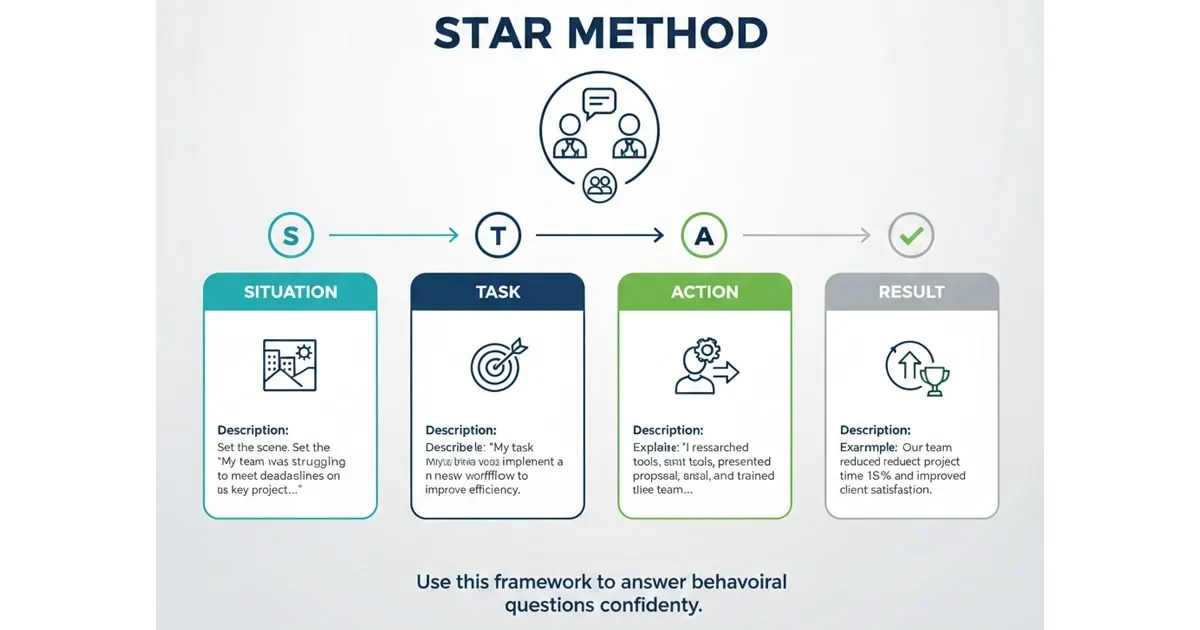
STAR Method 2026: Top Behavioral Interview Questions & Answers
You have a behavioral interview coming up, and the difference between a vague, forgettable answer and one that gets you the offer comes down to a single framework used consistently and well.
By the end of this guide, you'll know exactly how to structure every behavioral answer using the STAR method, which questions to prepare for first, what interviewers are silently scoring you on, and the mistakes that quietly eliminate otherwise strong candidates.
What interviewers are actually evaluating in behavioral interviews

Most candidates miss this: behavioral questions aren't just about the story. They're about the signal your story sends. When a hiring manager asks, "Tell me about a time you led a team through a difficult project," they're not curious about that specific project. They're running a mental checklist.
According to NACE's Job Outlook 2026 report, 87% of employers now use behavioral interviews as a primary assessment tool, precisely because past behavior is the best available predictor of future performance. Research from the Journal of Applied Psychology puts it in numbers: structured behavioral interviews predict job performance with roughly 55% accuracy, compared to just 10% for unstructured, conversational interviews.
What are they actually scoring? Here's the hidden rubric:
- Self-awareness: Do you understand your own role in what happened, including your missteps?
- Ownership: Did you take meaningful action, or did your team just figure it out collectively?
- Impact: Can you tie your actions to a measurable result, not just a vague positive outcome?
- Judgment: Did you make the right call under pressure, ambiguity, or constraint?
- Communication: Is your story clear, structured, and easy to follow without prompting?
LinkedIn Talent Solutions data reinforces this: 92% of talent professionals now rate soft skills as equally or more important than technical abilities. Behavioral questions are the primary instrument for measuring those skills, which is why companies currently spend roughly 60% of interview time on behavioral questions versus 40% on technical ones.
Know the rubric. Then build your answers around it.
How to prepare for behavioral interviews: a step-by-step plan

Preparation isn't about memorizing scripts. It's about building a library of flexible stories you can deploy confidently. Here's how to do it in five steps.
Step 1: Audit the job description for competency signals (Day 1)
Read the job description and highlight every skill, value, or behavior mentioned: words like "collaboration," "adaptability," "ownership," "problem-solving," and "communication." These are your preparation targets. Most roles surface five to seven core competencies, and nearly every behavioral question maps to one of them.
Step 2: Build your story bank (Days 1-3)
Identify six to eight strong professional stories from your experience, one per core competency. Each story should come from the last three to five years where possible. For recent graduates, internships, academic projects, and volunteer work all count. Aim for variety: don't pull all your examples from the same job or the same type of challenge.
Step 3: Structure every story using STAR (Days 2-4)
Apply the STAR framework to each story:
- Situation (20% of your answer): Set the context briefly. Where were you? What was the business environment?
- Task (10%): What was your specific responsibility or goal?
- Action (60%): What did you personally do, step by step? This is your real opportunity to shine, so don't rush it.
- Result (10%): What happened? Quantify it wherever possible.
That time allocation comes from MIT Career Advising guidance, and it points to the single most important shift most candidates need to make: your Action section should be roughly half your total answer. That's where your skills live. Spend time there.
Step 4: Quantify every result you can
Apply the golden rule: if your STAR story doesn't include a number (a percentage, a dollar figure, time saved, a user count) it's not ready. Interviewers remember data. They forget adjectives. "Improved team efficiency" is forgettable. "Reduced onboarding time by 30% across a team of 12" is not.
Step 5: Practice out loud, not in your head (Days 3-5)
Recording yourself answering is uncomfortable and worth it. You'll catch filler words, rambling Situation sections, and results you glossed over. Aim for answers between 90 seconds and 2.5 minutes. Shorter feels rushed; longer risks losing the interviewer.
Bonus: Consider the SOAR variant for complex stories
The SOAR method (Situation, Obstacle, Action, Result) works well for stories involving real adversity. By naming the specific obstacle rather than just the task, you create narrative tension that makes your answer more memorable. Use it when the challenge itself is the most impressive part of the story.
Top behavioral questions answered: question-by-question breakdown
Only 34% of candidates arrive with fully prepared STAR examples, according to current hiring data. That gap is your opportunity. Here are the highest-frequency behavioral questions by competency, with sample answers you can adapt immediately.
"Tell me about a time you showed leadership."
Why it's asked: Interviewers want to see whether you can influence outcomes beyond your formal authority, which is a signal of potential for growth.
Sample answer (STAR): "At my previous company, our team was halfway through a product launch when our project lead left unexpectedly, two weeks before the go-live date. (Situation) Someone needed to coordinate the remaining workload across three teams. (Task) I volunteered to take point. I mapped out what was outstanding, held a 30-minute daily standup to surface blockers early, and personally handled the client communication so the rest of the team could focus on delivery. (Action) We launched on schedule. The client rated the handover 9/10 in their post-project survey, and our VP later cited it as a model for how we handle transitions. (Result)"
Customization note: Swap the context to match your industry. The structure (gap identified, you stepped in, specific actions taken, measurable outcome) is what matters.
"Describe a time you had to work with someone whose personality was very different from yours."
Why it's asked: Communication is LinkedIn's #1 in-demand skill for 2026. This question probes emotional intelligence, conflict tolerance, and collaborative maturity.
Sample answer (STAR): "I was paired with a colleague on a client proposal who had a very different working style. He wanted to improvise the presentation; I prefer detailed outlines and rehearsal. (Situation) We had one week to deliver a proposal worth roughly $200K in potential revenue. (Task) Rather than forcing my approach, I set up a working session to align on structure first, then gave him creative latitude within that framework. I drafted the outline; he shaped the narrative. (Action) We won the contract, and the client specifically mentioned the presentation felt both organized and compelling. My colleague and I went on to collaborate on two more bids after that. (Result)"
Customization note: The key signal here isn't that you agreed with the other person. It's that you adapted your approach to make the collaboration work anyway.
"Tell me about a time you dealt with unexpected change."
Why it's asked: Adaptability ranks among the top three fastest-growing skills employers seek, according to LinkedIn's 2025 Skills on the Rise report. In a world of shifting priorities, interviewers want evidence you don't freeze.
Sample answer (SOAR): "Three months into a market expansion project I was leading, the company decided to pivot our target region entirely based on new competitor data. (Situation) The obstacle: we had already committed six weeks of research and two vendor agreements to the original region. (Obstacle) I organized a one-day reset workshop with the team to map what was transferable, renegotiated one vendor agreement, and rebuilt our market brief for the new region in ten days. (Action) We stayed within the original project timeline and under budget by 8%. The new region ended up outperforming our initial projections by 22% in the first quarter. (Result)"
Customization note: Focus your answer on speed of adjustment and what you did to help others adapt, not just that you personally coped.
"Give me an example of a time you solved a complex problem."
Why it's asked: This tests analytical thinking, structured reasoning, and your ability to navigate ambiguity, all skills that are hard to fake.
Sample answer (STAR): "Our customer support team was seeing a 40% spike in ticket volume after we launched a new feature, but the root cause wasn't obvious. (Situation) I was tasked with diagnosing and resolving it within two weeks to protect our satisfaction scores. (Task) I pulled ticket data, tagged them by issue type, and found that 68% mapped to a single misunderstood UI element. I worked with the product team to add a tooltip and updated our onboarding email sequence. (Action) Within three weeks, ticket volume dropped 35% and our CSAT score climbed from 74 to 81. (Result)"
Customization note: Walk through your diagnostic process, not just your solution. Interviewers want to see how you think, not just what you did.
"Tell me about a mistake you made and how you handled it."
Why it's asked: Self-awareness and accountability matter for almost every role. Interviewers are checking whether you own your errors or deflect them.
Sample answer (STAR): "Early in my role as a data analyst, I published a monthly performance report with an error in the revenue formula. The mistake went out to senior leadership before I caught it. (Situation/Task) As soon as I identified it, I notified my manager immediately, sent a corrected report with a clear explanation of what changed and why, and apologized directly to the leadership team. (Action) The trust impact was minimal because I caught and corrected it the same day. More importantly, I built a peer-review step into our reporting process so no single analyst could publish without a second set of eyes. We haven't had a similar error since. (Result)"
Customization note: The mistake itself matters far less than your response to it and, crucially, what you changed afterward. Show learning, not just regret.
Mistakes that eliminate candidates
These aren't nerves or wardrobe choices. These are structural errors that cause interviewers to score you down silently.
- Spending 80% of your answer on Situation and Task. Fix: time yourself. Your Action section must be the longest part.
- Using "we" throughout instead of "I." Fix: name the team's context, then say explicitly what you personally did.
- Giving a result with no numbers. Fix: even rough figures ("saved approximately 10 hours per week") beat vague positives like "the team was much happier."
- Choosing a story that doesn't actually answer the question. Fix: before you start, say the question back to yourself internally and confirm your story demonstrates that specific competency.
- Ending your answer without a result. Fix: always close with what happened. Don't trail off after the action. The result is the payoff.
- Preparing only one or two stories and forcing them to fit every question. Fix: build a bank of six to eight distinct stories covering leadership, teamwork, adaptability, problem-solving, failure, and initiative.
- Answering hypothetically instead of with a real example. Fix: if you can't recall a perfect example, use a close analog and say so briefly. "The most relevant example I have is from a class project, and here's why it applies..." works fine.
Pre-interview prep checklist
Use this the day before and the morning of your interview.
- Reviewed the job description and identified the top five competencies being assessed
- Built a story bank of at least six STAR or SOAR examples, one per competency
- Every story includes a quantified result (%, $, time, users, score)
- Practiced each answer out loud and timed it (target: 90 seconds to 2.5 minutes)
- Action section is the longest part of each answer
- Stories use "I" for personal actions, not "we" throughout
- Prepared at least one story that involves a failure or mistake, with a clear learning
- Ready to answer: "Tell me about a time you showed leadership," teamwork, adaptability, problem-solving, and a mistake
- Have two to three clarifying questions ready if an interviewer's behavioral prompt is vague
- Know the company's stated values and align at least one story to those values naturally
Frequently asked questions
How long should a STAR method answer be?
Aim for 90 seconds to 2.5 minutes per answer. Shorter than 90 seconds usually means you've skipped important detail in the Action section. Longer than two and a half minutes risks losing the interviewer's attention, especially in panel or video interviews. If you're regularly running over three minutes in practice, your Situation section is almost certainly too long.
Can I use the same story for multiple questions?
Yes, but carefully. A single strong experience can demonstrate leadership and problem-solving, for example, but only if you adjust which elements you emphasize. Don't recycle a story verbatim. If the interviewer has already heard a particular example, flag it: "I touched on this situation earlier, but I want to highlight a different aspect of it."
What if I don't have work experience yet?
Academic projects, internships, volunteer work, team sports, and student leadership all count. Interviewers asking behavioral questions want to assess how you think and act. The professional context matters less than the quality of your story. Just be transparent: "During my final-year project..." or "When I volunteered with..." establishes the context clearly.
How is the SOAR method different from STAR, and when should I use it?
SOAR replaces "Task" with "Obstacle," making the challenge the centerpiece of your story rather than the assignment. Use SOAR when the difficulty of what you overcame is the most compelling part of your answer: a failed project, a high-stakes turnaround, or a situation where the odds were genuinely against you. STAR works better for straightforward achievement stories; SOAR works better for adversity and resilience narratives.
Do behavioral interviews work differently in virtual or AI-assisted formats?
The structure of your answers doesn't change. STAR is STAR whether you're in a room or on a screen. What changes is delivery. In video interviews, maintain eye contact with the camera (not your own image), speak slightly slower than you think you need to, and pause briefly before answering to signal that you're thinking rather than reciting. AI-assisted interview platforms, now used by a growing number of large employers, evaluate your answers for keyword alignment, pacing, and response structure. That makes STAR an even stronger advantage: structured answers score better algorithmically as well as with human reviewers.
Behavioral interviews reward preparation, not performance. You don't need to be a natural storyteller. You need six to eight strong, honest, well-structured examples and the discipline to deliver them clearly. Start with your story bank today. Pick one competency, write a STAR story, quantify the result, and practice it out loud. Do that six times, and you'll walk into your next interview more prepared than most candidates ever are.
Editor's Picks
 News
News 57,000 Jobs Added: How to Get Hired in the 2026 Slowdown
Jul 10, 2026
 Interviews
 Ace Your AI Video Interview in 2026: HireVue Tips & Prep Guide
Jul 10, 2026
 Resume
 Beat AI-Powered ATS in 2026: What Your Resume Must Do Now
Jul 10, 2026
 Skills
 Best AI Skills to Put on Your Resume in 2026 (Get Hired Fast)
Jul 10, 2026