Negotiate Your Salary in 2026: Scripts, Data & Winning Tactics
Learn how to negotiate your salary in 2026 with real scripts, market data, and proven tactics. Stop leaving money on the table — most employers expect you to ask.
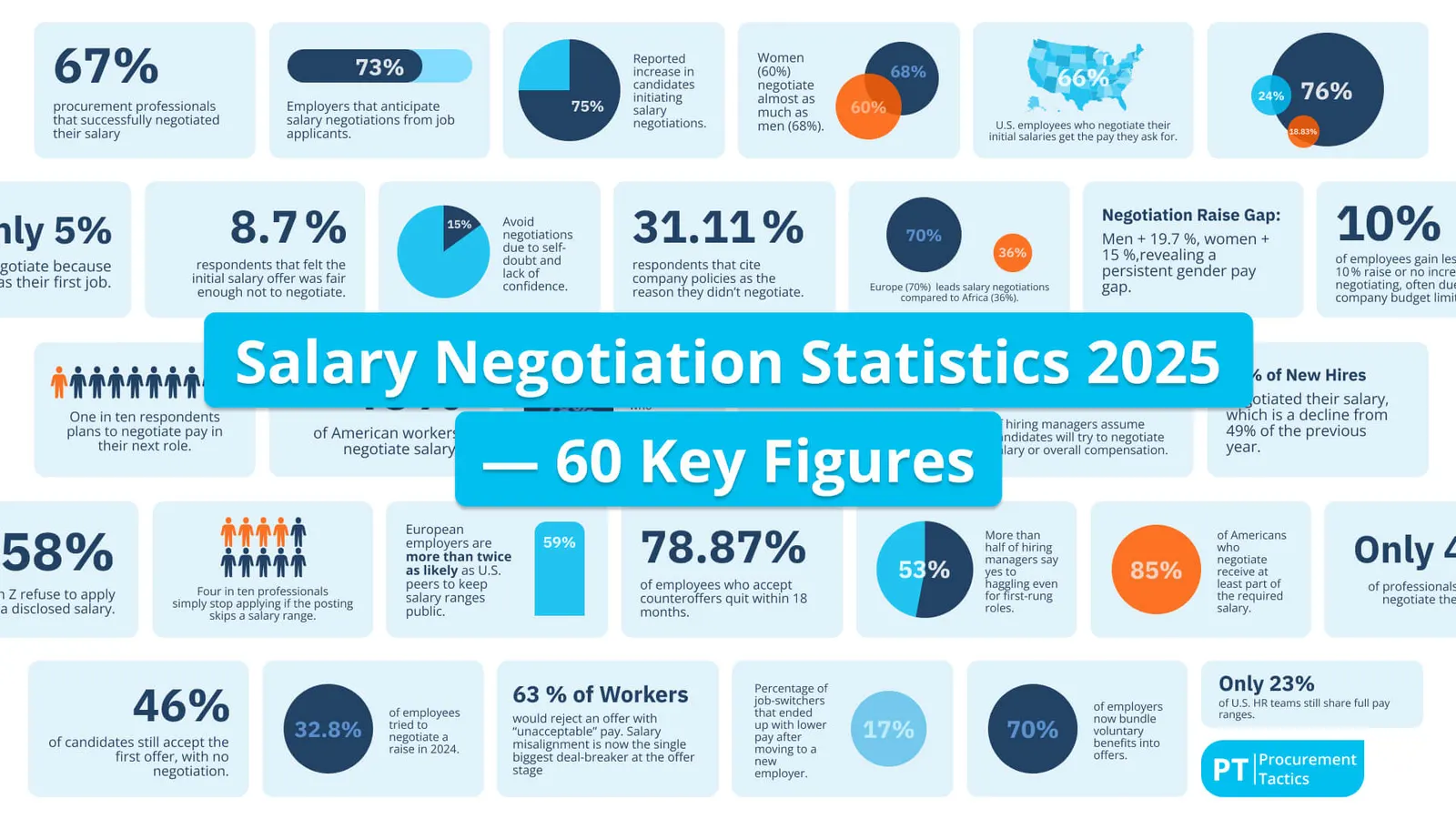
Negotiate Your Salary in 2026: Scripts, Data & Winning Tactics
Most people walk away from a job offer without negotiating and quietly lose thousands of dollars they could have kept.
That's not a judgment. It's a data point. Only 39% of workers negotiate their salary when accepting a new role, which means the other 61% leave an average of $7,500 on the table right at the start. Over a career, that shortfall compounds (every raise, 401(k) match, and future offer anchors to your starting number) and can reach anywhere from $320,000 to $1 million in lifetime earnings, according to PayScale research.
By the time you finish this article, you'll know what the 2026 market looks like, why negotiating is safer than you think, and what to actually say when the offer lands on the table.
Why most people don't negotiate (and why the fear isn't rational)

- 41% of candidates don't negotiate because they don't know what's actually negotiable.
- 36% can't justify their ask. They have a number in mind but no evidence to back it up.
- 29% simply don't know their market value.
- Many fear the offer will be rescinded if they push back, but nearly nine in ten hiring managers keep the offer on the table even after tough bargaining.
Employers expect negotiation. A CareerBuilder survey found that 73% of employers are willing to negotiate an initial offer. When you accept without a counter, you're not being gracious. You're leaving money that was already budgeted for you.
The 2026 market context you need to know

Before you name a number, understand what you're negotiating in.
Annual raise budgets are holding steady, but modest. Mercer's 2026 Compensation Planning Survey of more than 1,000 US organizations found that employers plan to hold base salary increases for merit at 3.2%, with total increases at 3.5%, matching 2025's actual figures. The Bureau of Labor Statistics confirmed wages and salaries in private industry rose 3.4% over the 12 months ending March 2026. That's your baseline for what "staying put" looks like.
The job-switching premium still exists, but it's narrowed. Wage growth for job switchers averages 4.4% versus 3.9% for job stayers in the latest reading. That gap used to be far wider (switchers were seeing 5.8% vs. 3.1% as recently as 2023). The broader average salary increase when changing jobs still lands between 8% and 15%, but you need to negotiate to capture it. It won't come automatically.
Pay transparency laws are your new research tool. As of 2026, 17 states plus Washington, D.C. require employers to disclose salary ranges in job postings, including California, Colorado, New York, Illinois, Washington, and Massachusetts, among others. Roughly half the U.S. workforce now works under some form of salary disclosure requirement. If you're applying in any of those states, the range is legally required to be in the posting. Use it. That number tells you where the ceiling actually is.
Your preparation framework: 5 steps before you say a word
Great negotiators don't wing it. They prepare like they're going into a deposition.
Anchor your number in real data. Pull salary ranges from at least three sources: the job posting itself (if transparency laws apply), Glassdoor, LinkedIn Salary, Levels.fyi (for tech roles), and the Bureau of Labor Statistics Occupational Employment Statistics. Cross-reference to find where your experience, industry, and geography intersect.
Build your "evidence file." This is a short list of three to five bullet points of quantified achievements that justify your ask. Think revenue generated, costs reduced, projects delivered, team size led. You're not bragging; you're making the hiring manager's internal business case easier to approve.
Set three numbers before the conversation. Your target (what you actually want), your walk-away (the minimum that makes the role worth it), and your opening anchor (slightly above your target, to give room to "compromise" toward where you actually want to land).
Know what else is on the table. Base salary is one lever. Signing bonus, remote work flexibility, extra vacation days, equity, performance review timing, professional development budget: all of these are negotiable and often easier to move than base pay. If salary hits a wall, pivot there.
Practice out loud. Saying "I was hoping we could get to $X" feels wildly uncomfortable the first time. The fifth time, it's just a sentence. Practice with a friend, record yourself, or run it in a mirror. The goal is to sound calm and confident, not rehearsed.
The key scenarios and exactly what to say
Scenario 1: They ask for your salary expectations before making an offer
This is the most dangerous moment if you're unprepared. Naming a number too early costs you leverage.
What to say:
"I'd prefer to learn more about the full scope of the role and your compensation structure before settling on a number. I want to make sure we're aligned on responsibilities first. That said, based on my research and experience, I'm targeting the range of [$X to $Y]. Is that in the ballpark for this position?"
Why this works: You've deflected the anchor trap, shown you've done your research, and invited a collaborative response, all in two sentences.
Scenario 2: The offer comes in and it's lower than you wanted
Don't accept on the call. Don't panic. Thank them genuinely, ask for 24 to 48 hours, and come back with this:
What to say:
"Thank you. I'm genuinely excited about this opportunity, and I've thought carefully about the offer. Based on my research into market rates for this role in [city/industry] and the [X years of specific experience / Y result] I'd be bringing to the team, I was hoping we could get to [$Z]. Is there flexibility there?"
Why this works: You've opened with enthusiasm (protecting the relationship), backed the ask with evidence (giving them a reason to approve it internally), and asked a closed question that requires a direct response.
Customise it: Swap in your specific proof point. "The $2.3M pipeline I managed at my last role" lands harder than "my experience in sales."
Scenario 3: They say the salary is fixed, this is the budget
This is rarely as final as it sounds. Try this:
What to say:
"I appreciate you being upfront about that. If the base is set, I'd love to explore whether there's flexibility on [the signing bonus / an earlier performance review / remote work policy / additional PTO]. What can we look at?"
Why this works: You're not challenging their statement; you're accepting it at face value and immediately pivoting to adjacent value. Hiring managers often have more flexibility on non-base-salary items than on the line items finance has locked down.
Scenario 4: You're currently employed and asking for a raise
This conversation is different. You don't have an offer as leverage, so your evidence file does the heavy lifting.
What to say:
"I've been thinking about my compensation in context of what I've contributed this year and what the market looks like for this role. [Result 1, Result 2], and based on salary data I've pulled from [source], the market rate for this scope of work is around [$X]. I'd like to discuss moving my base to [$Y]. Can we talk about making that happen?"
Why this works: You've linked the ask to business outcomes (not personal need), cited external data (making it about the market, not you), and framed it as a conversation, not an ultimatum.
Mistakes that eliminate your leverage
Even well-prepared candidates make these errors. Here's what to avoid and the one-sentence fix for each.
Accepting on the spot. Always ask for 24 to 48 hours to review. It's standard, it costs you nothing, and it gives you time to prepare a counter. Fix: Say "Thank you so much. I'd like a day to review everything carefully. Can I get back to you by [date]?"
Anchoring too low "to be safe." Starting below your target gives you nowhere to go. Fix: Open at or slightly above your target number; you can always come down.
Citing personal financial need. "I need $X to cover my rent" is irrelevant to a hiring manager. Fix: Always anchor your ask to market data and your demonstrated value, not your expenses.
Negotiating over email without any prior verbal signal. A cold counter-offer email with no warmth or context reads as transactional and can sour the relationship. Fix: Have a brief call first to re-express enthusiasm, then follow up in writing to confirm.
Stopping at "no" too quickly. "We can't do more on base" is not the same as "we can't do more." Fix: Always respond to a no by asking what is possible, then work the other variables.
Apologising for negotiating. Phrases like "I'm sorry to ask, but..." signal that you think the ask is unreasonable. It isn't. Fix: Lead with confidence. "Based on my research..." not "I hope this isn't too much to ask..."
Pre-negotiation checklist
Run through this before any salary conversation, whether it's a new offer or a raise request.
- Pulled salary data from at least two external sources (Glassdoor, LinkedIn Salary, BLS, Levels.fyi, or the job posting itself)
- Identified my target number, opening anchor, and walk-away minimum
- Written out 3 to 5 quantified achievements I can cite to justify the ask
- Researched what non-salary items are negotiable at this company (equity, bonus, PTO, remote days, review timing)
- Practised my opening script out loud at least three times
- Requested (or planned to request) 24 to 48 hours before giving a final answer
- Confirmed whether the role/location is covered by a pay transparency law and checked the posted range
- Prepared a pivot script in case base salary hits a ceiling
- Reviewed any competing offers or market alternatives I can reference (without bluffing)
- Set a follow-up date so the conversation doesn't stall
FAQ: Salary negotiation in 2026
Can negotiating actually get an offer rescinded? Almost never. Research consistently shows that nearly nine in ten hiring managers keep the offer on the table after negotiation. Employers expect candidates to counter; it's a normal part of hiring. Rescission typically happens only when a candidate is rude, makes wildly unreasonable demands, or has misrepresented their background. A professional, evidence-backed counter-offer carries essentially zero rescission risk.
How much should I ask for above the initial offer? A common and effective approach is to counter 10 to 20% above the initial offer, which leaves room to meet in the middle at or near your actual target. People who negotiated in recent studies received an average increase of 18.83% from their original offers, so asking for that range is not aggressive. It's statistically normal.
What if I don't have a competing offer to use as leverage? You don't need one. Market data is leverage. A well-researched salary range from credible sources (BLS, LinkedIn, Glassdoor, pay-transparency job postings) is often more persuasive than a competing offer because it's objective. Pair it with your achievement evidence and you have a strong case.
Is it harder to negotiate remotely or via email? Slightly. You lose the real-time rapport of an in-person conversation. The fix: always negotiate by phone or video call first, express your enthusiasm verbally, then follow up with a written summary of what you discussed. Never lead with a cold counter-offer email; build the relational warmth first, then put the details in writing.
Does negotiating a starting salary really affect long-term earnings that much? Yes, significantly. Because most raises are calculated as a percentage of base, a higher starting point compounds over time. Factor in 401(k) matching, Social Security benefits calculated on lifetime earnings, and the fact that future employers often reference current compensation, and PayScale's data suggests a single successful negotiation can be worth over $1 million in lifetime earnings for college graduates. That's not a hypothetical. It's the math of compounding.
The numbers are on your side. Employers expect you to negotiate, most offers have room to move, and the worst realistic outcome of a professional counter-offer is a polite "this is our best." What you won't get back is the money you left on the table by staying silent. You've got the scripts, the data, and the framework. The only thing left is to use them.
Start with your research. Build your evidence file today. When the offer comes, you'll be ready.
Editor's Picks
 News
News 57,000 Jobs Added: How to Get Hired in the 2026 Slowdown
Jul 10, 2026
 Interviews
 Ace Your AI Video Interview in 2026: HireVue Tips & Prep Guide
Jul 10, 2026
 Resume
 Beat AI-Powered ATS in 2026: What Your Resume Must Do Now
Jul 10, 2026
 Skills
 Best AI Skills to Put on Your Resume in 2026 (Get Hired Fast)
Jul 10, 2026