One Page vs. Two: Resume Length Rules That Get You Hired in 2026
One page or two? Find out exactly how long your resume should be in 2026 — with a career-stage framework, recruiter data, and a ready-to-use checklist.
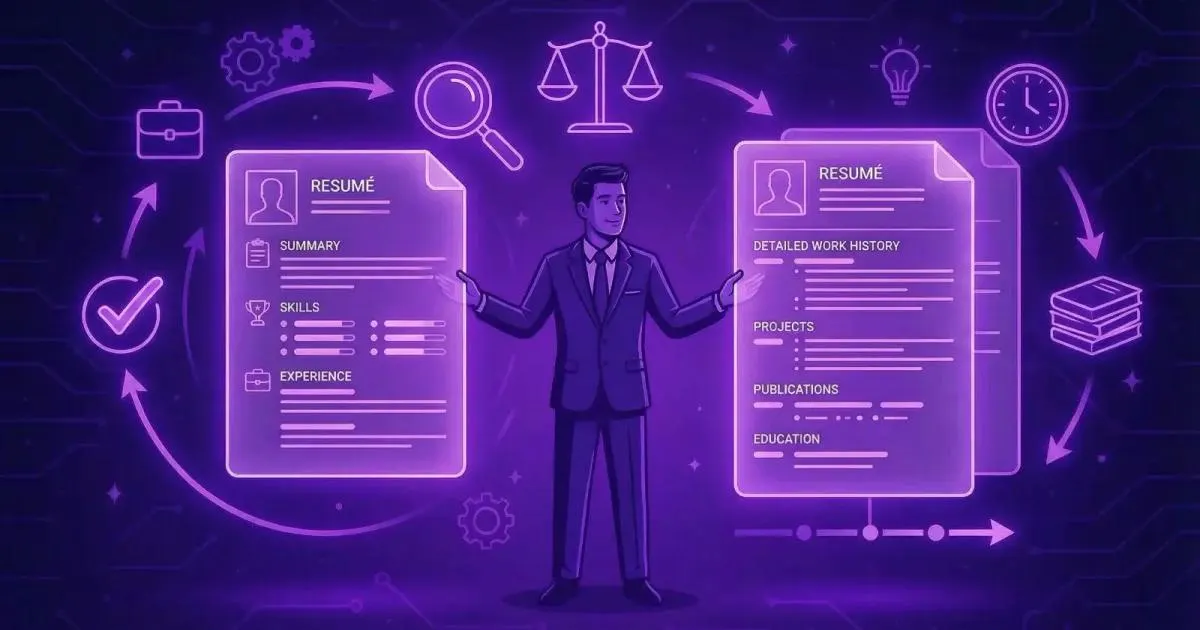
One Page vs. Two: Resume Length Rules That Get You Hired in 2026
You've spent hours perfecting your resume, and then you freeze at one question: is one page enough, or will a two-pager hurt your chances?
It's one of the most searched resume questions of 2026, and the answer you're probably carrying around is wrong. The old "one page, always" rule was built for a world of printed CVs and handshake applications. That world is gone. What you need now isn't a page-count rule. It's a relevance-per-page framework that matches your career stage and the role you're targeting. This article gives you exactly that, backed by real recruiter data and a checklist you can apply tonight.
The one-page rule is dead, but "more is more" isn't the answer either
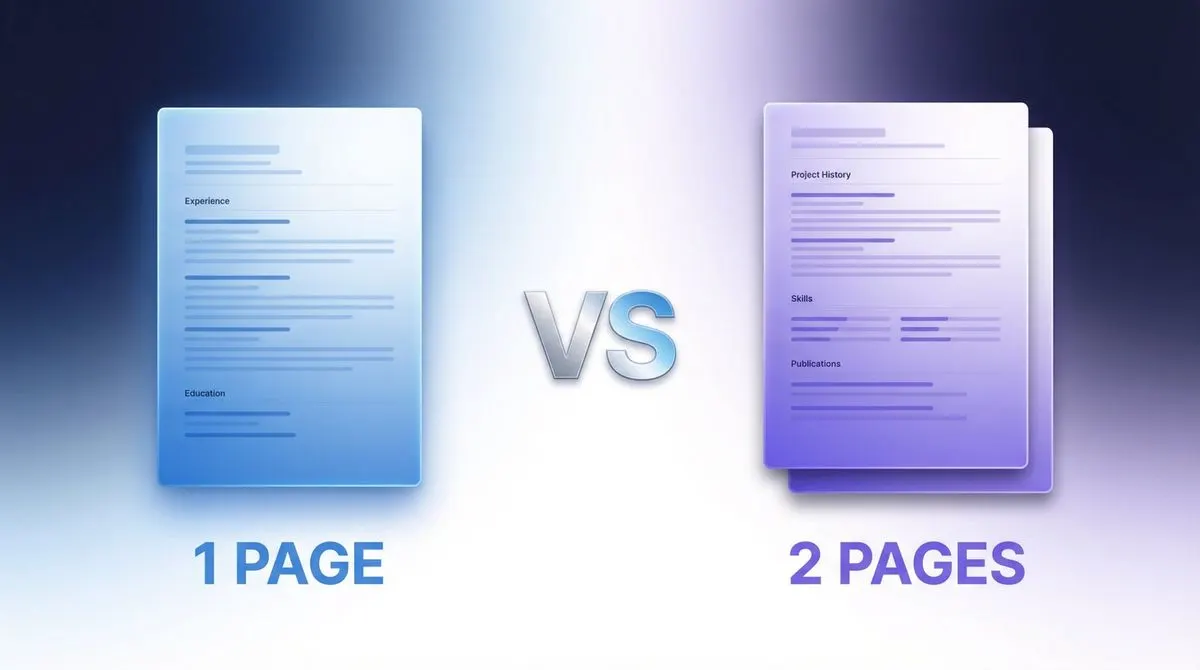
The one-page resume is no longer a universal standard, and two pages is no longer a bold choice. It's now closer to the default. Research comparing 50,000 resumes found that the average length jumped from roughly 312 words in 2018 to 503 words in 2023, nearly double, and squarely in two-page territory. Separately, Enhancv's analysis of current resume data shows that 47% of resumes submitted today are two pages, 43% are one page, and about 10% run even longer.
But longer isn't automatically better. The principle that actually governs resume length in 2026 is simple: every line must earn its spot. A bloated two-pager full of outdated roles and vague bullet points will hurt you more than a tight one-pager that leads with results. The question isn't "how many pages?" It's "how much relevant content do I actually have?"
What recruiters actually prefer right now (and why it matters)
The survey data on this is unusually consistent, and it leans clearly toward two pages for most candidates.
- A 2025 survey of 1,013 HR professionals found 82.1% say 1-2 pages is ideal, with 51% specifically preferring two pages. Only 31% still said one page is best.
- FlexJobs reports that 90% of recruiters prefer a two-page resume in general.
- 54% of hiring managers favor two pages (Resume Genius, 2024), and 53% of recruiters now expect two pages because ATS systems score keyword density across the full document. More relevant content means a higher match score.
- A ResumeGo study of 482 recruiting professionals found recruiters were 2.3 times more likely to prefer two-page resumes overall and spent roughly twice as long reading them from experienced candidates.
That said, 17% of hiring managers still view anything beyond one page as a negative signal. So the answer isn't "always two pages." It's "the right length for your experience level." Read on to find out exactly where you fall.
The career-stage framework: exactly who should use one page vs. two
This is the decision tool the rest of this article is built around. Find your situation, follow the rule, then use the checklist at the end to pressure-test your draft.
Step 1: Identify your experience tier
Use this table to find your starting point:
| Experience Level | Recommended Length | Key Condition |
|---|---|---|
| 0-2 years (entry-level, new grad) | One page | Fill it. Don't leave half a page blank |
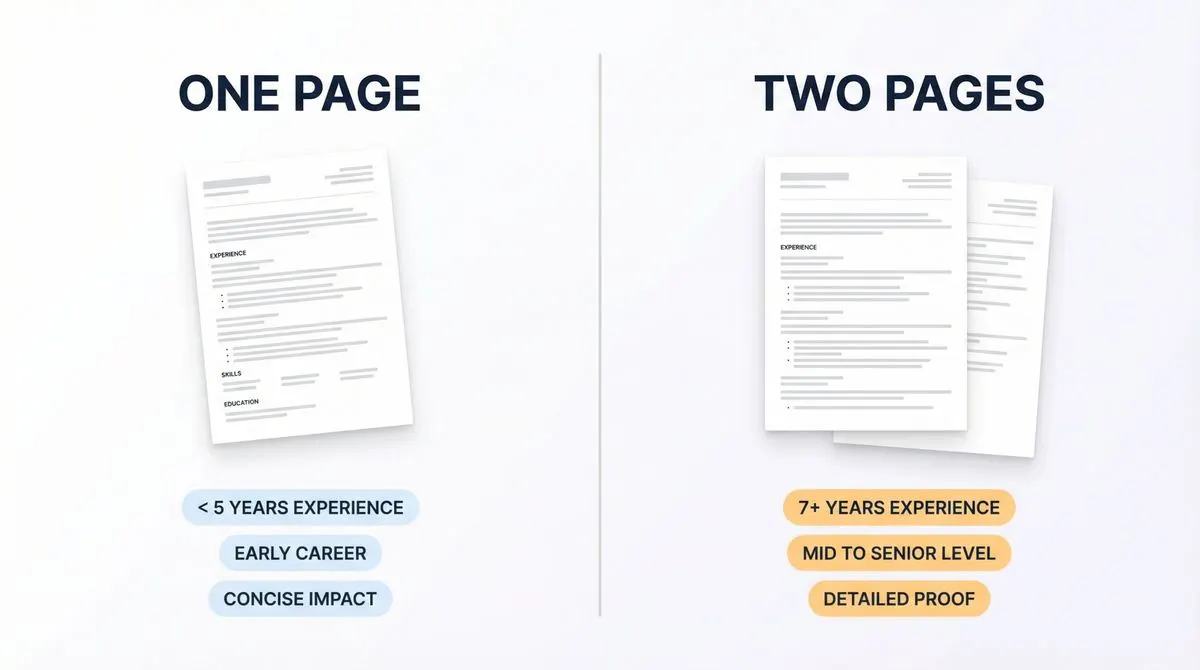
| 2-5 years (early-career) | One page (63% of HMs prefer this) | Two pages OK if internships/projects add real value |
| 5-10 years (mid-career) | One to two pages | Two pages if quantified results justify the space |
| 10+ years (senior/director) | Two pages | Two pages is the standard; page one must stand alone |
| C-suite / executive | Two to three pages | Include P&L ownership, board leadership, financial outcomes |
Step 2: Apply the half-page rule before you go to two pages
This is the rule most articles skip, and it's the one that will save your resume from looking like a formatting accident. Only extend to a second page if you can fill at least 50% of it with genuinely impactful content. A half-empty second page doesn't signal seniority; it signals a candidate who couldn't edit themselves. Harvard Business School's career office reinforces this: if you can't fill the second page meaningfully, cut back to one.
Step 3: Prioritize the top third of page one above everything else
LinkedIn's 2025 Hiring Trends data confirms recruiters spend an average of 7 seconds on their first scan, checking job titles, dates, and one standout achievement. A separate 2025 study measuring 4,289 anonymized resume reviews found an average initial scan of 11.2 seconds and a median total review time of 1 minute 34 seconds.
The practical implication: your first page earns the phone call. Your second page provides the detail needed for a meaningful conversation. If your summary and top three bullet points don't immediately signal "I'm a strong match," it doesn't matter how polished page two is. Nobody will get there.
Weak opening (before):
Experienced professional with strong communication skills and a passion for delivering results in fast-paced environments.
Strong opening (after):
Senior Marketing Manager with 8 years leading B2B demand generation. Grew qualified pipeline by 140% in 18 months at a $50M SaaS company by rebuilding the content and paid-search strategy from the ground up.
Step 4: Run every bullet through the "earn its spot" test
For each bullet point on your resume, ask: does this tell the hiring manager something specific about what I can do for them? If it's a generic duty ("responsible for managing social media accounts"), cut it or rewrite it with a result.
Before: Managed social media accounts for the brand. After: Grew Instagram following from 4,200 to 31,000 in 12 months by launching a weekly video series, which increased referral traffic to the website by 67%.
Do this for every bullet. You'll likely find that tightening your content answers the length question for you. Either you fill two pages naturally, or you realize one page is right.
Step 5: Check whether the job posting gives you a length signal
Some industries and companies still enforce one-page requirements, particularly consulting firms, investment banks, and certain government roles. If the posting says one page, that instruction overrides everything else in this article. Ignoring it signals you can't follow directions.
Step 6: Factor in your ATS keyword density
Here's something most length guides ignore: ATS systems score keyword density across your entire resume. A two-page resume naturally gives you more space to incorporate relevant terms from the job description without keyword-stuffing. This is one reason 53% of recruiters now expect two pages. They know longer resumes tend to score better in systems like Workday, Greenhouse, and iCIMS. If you're targeting a role at a large company that uses ATS (which is most of them), a well-filled two-pager gives you a structural advantage.
Step 7: Do a final read as if you're the recruiter
Print it out or view it at 75% zoom. Ask yourself:
- Does page one stand on its own as a compelling case?
- Is there anything on page two that should move up to page one?
- Is anything on either page just filler I kept because I worked hard on it?
Cut what doesn't serve the reader. The goal is a resume a recruiter can process quickly and want to read in full.
How resume length changes by industry and situation
Career changers
When you're switching industries, a focused one-page resume is almost always more effective. Your goal is to cut the noise (roles and accomplishments that don't transfer) and put the spotlight on the skills and results that do. A two-pager full of irrelevant experience signals confusion, not depth. Lead with a strong summary that names the role you're targeting and the transferable value you bring.
Tech roles
Tech recruiters report they rarely see single-page resumes anymore, and may actually ask for more detail if you submit a sparse one-pager. For software engineers, data scientists, and product managers with 3+ years of experience, a two-page resume is expected. Use the extra space for a skills section covering languages, frameworks, and tools, and show the scope and impact of your projects with specific metrics.
Recent graduates
One page is your default, but make it a full page. A resume that ends halfway down looks like you ran out of things to say. Lean on coursework, projects, internships, certifications, and extracurricular leadership to fill it meaningfully. If you have a rich research background or multiple internships, a full two pages is defensible.
Senior and executive candidates
Two pages is the new standard at the director level and above. A one-page executive resume signals under-qualification. C-suite candidates can go to three pages when they have genuinely differentiated content: P&L ownership with financial outcomes, board-level leadership, multi-company transformation results. Every claim should be quantified. Titles, scale, and dollar figures do the heavy lifting.
Common resume length mistakes to avoid
- Padding with duties instead of results. Filling space with job descriptions ("responsible for...") wastes every inch. Replace them with outcomes. Fix: rewrite at least 70% of bullets as achievement statements with numbers.
- The half-empty second page. This is the most common length error in current resume data. Fix: either cut back to one page or add substantive content such as certifications, a notable project, or a publications/speaking section if relevant.
- Shrinking margins and font to fake one page. Margins below 0.5" and fonts below 10pt make your resume harder to scan and feel desperate. Fix: if it doesn't fit cleanly, go to two pages or cut content.
- Burying the strongest content on page two. Recruiters scan page one first, always. Fix: move your biggest career win to the top third of page one.
- Ignoring the job posting's length requirement. Fix: search the posting for any mention of page length, resume format, or "no more than X pages" before you finalize.
- Using a two-page resume when you have five years or less of experience. 63% of hiring managers prefer one page for candidates under five years. Fix: use the career-stage table above and stay honest about what you actually have to show.
Your resume length decision checklist
Use this before you submit any application. Check every box. If you can't, that's your edit list.
Page count decision:
- ✅ I've identified my experience tier using the career-stage framework
- ✅ If using two pages, page two is at least 50% full of relevant content
- ✅ I've checked the job posting for explicit page-length instructions
- ✅ I've considered the industry norm (consulting/finance leans toward one; tech/senior roles lean toward two)
Page one quality:
- ✅ My professional summary is 2-3 sentences and names my role, top value, and one result
- ✅ The top third of page one contains my most compelling achievement
- ✅ My most recent and most relevant experience appears clearly on page one
Bullet quality (every bullet):
- ✅ At least 70% of bullets include a quantified result (%, $, volume, time saved)
- ✅ No bullet starts with "responsible for" or "helped with"
- ✅ Every bullet answers "so what?" Not just what I did, but what it produced
Formatting health:
- ✅ Margins are between 0.5" and 1"
- ✅ Font is 10-12pt for body text, 14-16pt for your name
- ✅ No shrinking tricks used to force a page-count outcome
Frequently asked questions
Is a two-page resume always acceptable in 2026? For most candidates with five or more years of experience, yes. Two pages is now closer to the norm than the exception. A 2025 HR survey found 51% of recruiters specifically prefer two pages, and 70% of hiring managers prefer two pages for candidates with significant experience. The caveat: if the job posting requests one page or you're early in your career, default to one.
Will ATS systems penalize a two-page resume? No. Modern ATS platforms (Workday, Greenhouse, Lever, iCIMS) process multi-page resumes without any penalty. A well-filled two-page resume often scores better on keyword density than a one-pager, because you have more space to naturally incorporate terms from the job description. The only real ATS risk is complex formatting such as tables, text boxes, or graphics that the parser can't read. Page count itself is not the issue.
What if I have 10+ years of experience but want to keep it to one page? You can, but you'll likely be cutting content that actually qualifies you, and 70% of hiring managers expect two pages at that level. The better question is: what are you cutting, and why? If it's outdated roles from 15 years ago that aren't relevant, cutting is smart. If it's a quantified achievement from three years ago that's directly relevant, keep it and go to two pages.
Should my resume be exactly one or two pages, or can it be 1.5 pages? Aim for clean breaks: fill one page completely, or fill two pages to at least the halfway point of page two. A resume that ends at the middle of page two looks unfinished. If you're at 1.5 pages, either cut enough to land cleanly on one, or add enough substantive content to push meaningfully into page two.
Do hiring managers actually read the second page? Yes, if you pass the initial scan. Research shows that once a recruiter decides your resume is worth a closer look, they read the entire document before reaching out. The first page earns the interview; the second page arms the recruiter with enough detail to have a real conversation about your background. Both pages have to be good. Page two just doesn't have to win the first seven seconds.
Pick up your current resume right now and run it through the checklist above. You'll know within five minutes whether your length is serving you or costing you interviews. The goal isn't one page or two. It's the right amount of space, filled with the right evidence, presented so clearly that a recruiter has no reason to stop reading.
Editor's Picks
 News
News 57,000 Jobs Added: How to Get Hired in the 2026 Slowdown
Jul 10, 2026
 Interviews
 Ace Your AI Video Interview in 2026: HireVue Tips & Prep Guide
Jul 10, 2026
 Resume
 Beat AI-Powered ATS in 2026: What Your Resume Must Do Now
Jul 10, 2026
 Skills
 Best AI Skills to Put on Your Resume in 2026 (Get Hired Fast)
Jul 10, 2026