Ace Your AI Video Interview in 2026: HireVue Tips & Prep Guide
Beat your HireVue interview in 2026 with this expert prep guide: how AI scoring works, sample answers, common mistakes, and a ready-to-use checklist.
Ace Your AI Video Interview in 2026: HireVue Tips & Prep Guide
You just got a HireVue invitation. No interviewer, no small talk, just a camera staring back at you and a timer counting down.
That setup unnerves a lot of candidates, and understandably so. But HireVue is highly predictable once you understand how it works. By the end of this guide, you'll know what the AI is evaluating, how to structure answers that score well, which mistakes silently eliminate candidates, and how to walk into your recording session feeling prepared rather than ambushed.
What HireVue is actually evaluating
Before you prep a single answer, understand what's happening on the other side of that camera. HireVue's AI doesn't just transcribe your words. It processes multiple data streams at once to generate a score that often determines whether a human recruiter ever watches your recording. The AI scoring is the gating step. Candidates below the threshold are typically never seen.
What the system evaluates:
- Language and content: the relevance, structure, and specificity of your answers. Does what you say actually address the question, and does it show competency?
- Communication clarity: vocabulary range, filler word frequency ("um," "uh," "like"), sentence structure, and logical flow.
- Facial engagement and expression: eye contact with the camera (not the screen), appropriate expressiveness, and consistency between your tone and your words.
- Energy and vocal delivery: speaking pace, volume variation, and whether your delivery signals confidence or anxiety.
- Structured thinking: whether you follow a recognizable answer framework. The AI models are trained on tens of millions of completed interviews and reward organized, evidence-based responses.
HireVue has processed over 70 million completed interviews to train its models. It's used by 60% of Fortune 100 companies, including JPMorgan, Amazon, Goldman Sachs, Deloitte, Microsoft, Unilever, and Delta Airlines. If you're applying for an early-career, graduate, or high-volume role at a major employer in 2026, you'll very likely face it.
Your step-by-step HireVue prep plan
Treat this like a structured five-day sprint, not a last-minute scramble. Here's how to build real readiness.
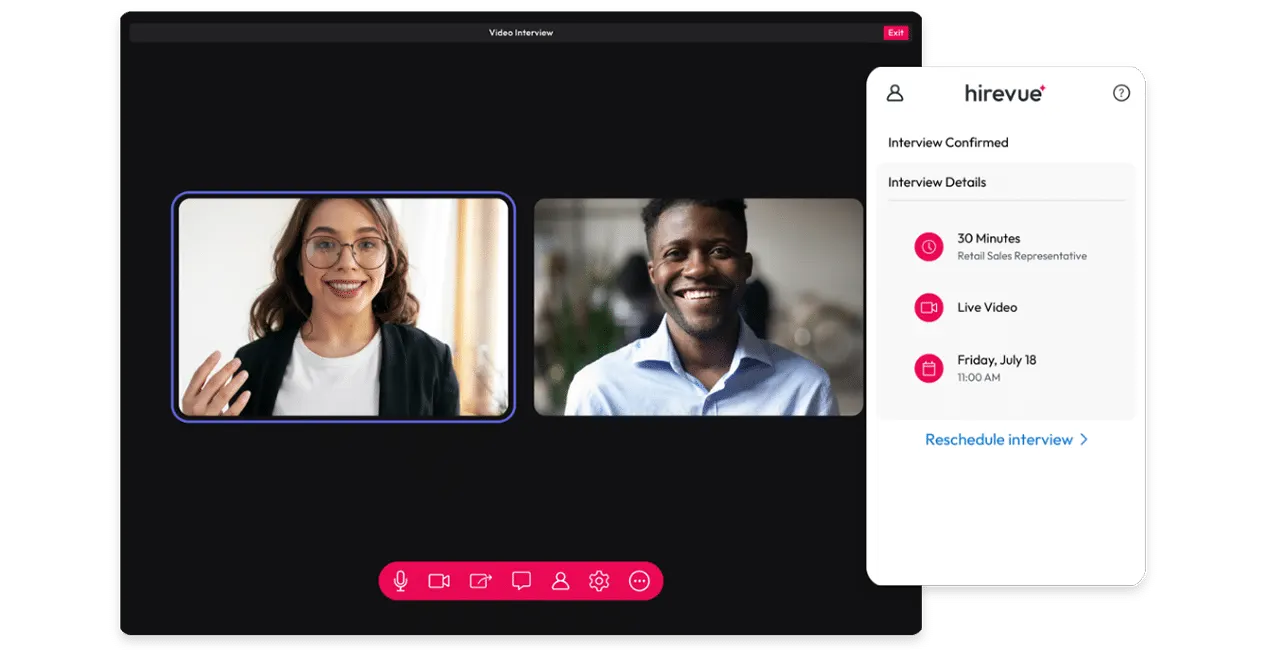
1. Confirm the format before you record. Open the invitation link and read every line. It will tell you: number of questions (usually 3 to 5), prep time per question (typically 30 seconds), response time limit (usually 2 to 3 minutes), and whether retakes are allowed. Most employers allow zero or one retake per question. Know your rules before you start.
2. Master the STAR framework, then tighten it. HireVue questions are almost exclusively behavioral. STAR (Situation, Task, Action, Result) is the right structure, but don't treat each component equally. Spend roughly 10% on Situation, 10% on Task, 60% on Action, and 20% on Result. The AI and human reviewers both care most about what you specifically did, not the background context.
3. Prepare 6 to 8 core stories from your experience. Pick moments that show problem-solving under pressure, collaboration or leadership, a time you failed and recovered, a quantified achievement, and adaptability to change. These stories can be adapted to answer nearly any behavioral question you'll face.
4. Rehearse out loud, on camera. This is non-negotiable. Use your phone or laptop to record yourself answering practice questions. Watch the playback critically: Are you looking at the camera lens (not the screen)? Are you speaking too fast? Are your answers under two minutes? Forty-six percent of candidates now use AI tools to practice interviews. Do the same. Record, review, refine.
5. Set up your environment the day before. Choose a quiet room with a neutral or tidy background. Position your camera at eye level (stack books under your laptop if needed). Light your face from the front, not from behind. Natural light from a window works; a ring light works better. Wear what you'd wear to an in-person interview at that company: business casual at minimum. A plain, solid-color top reads cleanest on camera.
6. Run a full tech check. HireVue provides a 30-second equipment check at the start of every session, but don't rely on that alone. Test your webcam, microphone, and internet connection in advance. Use Chrome or the HireVue mobile app; both are officially supported. Close all other applications to protect your bandwidth and cut out pop-up distractions mid-answer.
7. Do a full dry run the day before. Record yourself answering three mock questions back-to-back with the timer running. This simulates the real pressure. Most candidates finish a five-question HireVue in 20 to 30 minutes. Know what that pacing actually feels like before the real session.
Breaking down the most common HireVue questions
"Tell me about yourself."
This is almost always the unscored practice question HireVue uses to warm you up. Treat it like it counts anyway. Use it to calm your nerves, confirm your setup looks right, and land a sharp 60-second professional summary. Structure it as: current role/background, key strength, why you're here.
"I'm a supply chain analyst with three years of experience at a mid-size logistics firm, where I led a cost-reduction initiative that saved the company $400K annually. I specialize in process optimization and data-driven decision-making, and I'm looking to bring that skillset to a high-growth operation like yours."
Keep it under 90 seconds. End on your why. It signals intent and engagement.
"Tell me about a time you handled a difficult situation at work."
Why they ask it: This is a core resilience and problem-solving probe. The AI is looking for structured thinking, personal accountability, and a real outcome, not a vague story about a "challenging team dynamic."
What strong looks like:
"In my second year as a project coordinator, our primary vendor missed a critical delivery two weeks before a product launch. I immediately mapped our alternative suppliers, negotiated an expedited order with a 15% premium, and rebuilt the project timeline to absorb the delay without pushing the launch date. The product launched on time, and I documented the contingency process so the team had a playbook for future disruptions."
Customization note: Swap the industry context freely, but keep the structure tight. One clear problem, one specific action sequence, one measurable or observable result.
"Why do you want to work here?"
Why they ask it: Motivation and cultural fit. A generic answer ("I admire your company's values") scores poorly because it signals no real research. Name something specific: a recent initiative, a product line, a stated strategic direction.
What strong looks like:
"I've followed your push into sustainable packaging over the past two years, and the 2025 supplier transparency report made it clear this isn't just a PR initiative. It's operationally embedded. That kind of systemic commitment is exactly the environment where I want to develop my sustainability expertise."
Customization note: Spend five minutes on the company's LinkedIn, newsroom, or annual report before you record. One specific, recent detail does more work than three generic compliments.
"Describe a time you worked with a difficult colleague."
Why they ask it: Interpersonal skills, emotional intelligence, and how you handle conflict without escalating it. The trap here is either badmouthing the colleague or being so diplomatic that you sound like you did nothing.
What strong looks like:
"A peer on a cross-functional project consistently missed handoffs that blocked my work. Rather than escalate immediately, I requested a one-on-one to understand their workload. It turned out they were managing two conflicting priorities without clear guidance. We agreed on a shared status update process, and by the end of the project our handoff accuracy was at 100%. The manager later adopted that process for the whole team."
Customization note: Always end with a positive outcome or a lesson applied. The AI and the human reviewer are both looking for resolution, not complaint.
Mistakes that get candidates eliminated
These aren't nervousness warnings. They're specific, avoidable errors that directly suppress your score.
Looking at your own face on screen instead of the camera lens. It reads as avoidance of eye contact. Fix: put a small sticky note or arrow above your camera to redirect your gaze.
Starting answers with filler phrases. "That's a great question" or "So, um, I would say…" burns your first five seconds and signals unpreparedness. Fix: pause, breathe, then start with your Situation.
Running significantly under the time limit. A 45-second answer to a 3-minute question signals a lack of depth. Fix: expand your Action section with specific steps and tools you used.
Using a retake unnecessarily. Research and practitioner experience consistently show that first takes score better because they sound natural. Fix: only retake if your answer was genuinely incomplete or off-topic.
Giving the same answer twice in different words. With 3 to 5 questions, candidates sometimes recycle the same story. Fix: prepare 6 to 8 distinct stories in advance so you always have a fresh example.
Ignoring audio quality. Poor audio degrades the AI's ability to analyze your language and delivery accurately, and it frustrates any human reviewer watching later. Fix: test your microphone in a quiet room; use a headset with a built-in mic if your laptop's is weak.
Recording in poor lighting. Backlit or dim setups obscure facial expression signals. Fix: face a window or use a front-facing lamp so your face is evenly lit.
Your HireVue prep checklist
Use this the day before and the day of your recording session.
- Read the invitation email fully: confirm question count, timing, and retake policy
- Prepare and rehearse 6 to 8 STAR stories covering key competency areas
- Research the company: find one specific, recent fact you can use in your "why this company" answer
- Test webcam, microphone, and internet connection
- Set camera at eye level; place a gaze cue above the lens
- Light your face from the front (no backlighting)
- Choose a quiet space with a neutral background
- Close all non-essential browser tabs and apps
- Dress as you would for an in-person interview at this company
- Do a timed mock recording: three questions back-to-back
- On the day: complete the unscored practice question to settle your nerves
- Speak to your 60% Action / 20% Result ratio in every answer
- After submission: send a follow-up thank-you email to your recruiter contact within 24 hours
Frequently asked questions about HireVue
Can the company see that I practiced or retook questions? Yes. HireVue logs all activity within a session, including whether you used a retake. Recruiters can see this data. It won't disqualify you from using the retake feature (that's why it exists), but it's one more reason to use it only when genuinely necessary.
How long does HireVue take to complete? Most candidates finish a 5-question HireVue in 20 to 30 minutes, including setup and the practice question. If the employer has added game-based assessments, expect 45 to 60 minutes total. Block out an hour to be safe, and don't start when you're rushed.
Do I have to complete it in one sitting? Not always. Some employers allow you to save progress and return. Most set a deadline, and the invitation will specify the expiration date and time. Complete it well before the deadline; technical issues close to the deadline are your problem, not theirs.
What if my internet connection drops mid-interview? Reconnect immediately and continue from where you left off. HireVue saves completed answers automatically. If the session ends before you finish, contact the recruiter right away, explain what happened, and ask for a new link. Most employers accommodate genuine technical failures promptly.
Does HireVue use facial expression analysis to score me? HireVue has historically used facial movement analysis, but the company has publicly committed to ongoing bias audits and model refinement. What you can control: look at the camera lens, let your natural expressiveness show, and match your facial energy to your words. Don't try to "perform" emotions. It reads as inauthentic to both the AI and any human reviewer.
You're now ahead of the majority of candidates walking into HireVue blind. The platform has been calibrated across tens of millions of interviews to identify candidates who communicate clearly, think in structured ways, and bring real evidence to their answers. That's exactly what you've just prepared to do.
Your next step: open a blank document right now and draft your 6 to 8 STAR stories. Then record yourself answering three practice questions on your phone. You'll know within that first playback exactly what to sharpen, and you'll walk into your real session ready.
Editor's Picks
 News
News 57,000 Jobs Added: How to Get Hired in the 2026 Slowdown
Jul 10, 2026
 Resume
 Beat AI-Powered ATS in 2026: What Your Resume Must Do Now
Jul 10, 2026
 Skills
 Best AI Skills to Put on Your Resume in 2026 (Get Hired Fast)
Jul 10, 2026
 Job Search
 Hidden Job Market 2026: Get Referred Before Jobs Are Posted
Jul 10, 2026